
Homelift by Garaventa Lift
For indoor and outdoor use
A homelift makes every floor of your home conveniently accessible and step-free. Whether for a new build or a retrofit, the compact design requires little space and usually does not need a dedicated lift shaft. With many design options, the lift blends into your architecture and interior, increases safety and independence in everyday life, and adds value to your property.
Homelifts for different living situations
Depending on your home, the number of floors, and the level of comfort you want, there are various homelifts to suit your situation. From a compact lift for two floors to a panoramic lift spanning multiple storeys, you can find the right solution for your home.
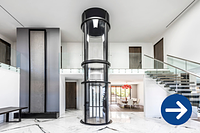
Savaria Vuelift Homelift
The panoramic homelift

Luma
The homelift that travels through the ceiling
What is a homelift?
A homelift is a compact elevator for a private home. It transports people and belongings comfortably between two or more floors and requires significantly less space than traditional elevators in office buildings or apartment blocks. The lift can be integrated into many existing homes and new builds, and it provides safe access to all floors, especially for older people and those with limited mobility.
At the same time, it makes everyday life easier for the whole family, for example when carrying groceries, beverage crates, or a stroller, and it increases living comfort and property value.
What are the benefits of a homelift?
- Step-free access: Reach all floors comfortably and safely.
- More comfort: Avoid climbing stairs and make everyday life easier.
- Flexible installation: Can be fitted indoors or outdoors, including in existing homes.
- Added value: Increases the property’s appeal and market value.
- Energy-efficient: Modern drive system with low power consumption.
- Space-saving: Requires little room and fits many floor plans.
- Safe: Comprehensive safety features for worry-free use.
- Modern design: Various versions to match your home’s style.
How much does a homelift cost?
All prices listed here include delivery, installation, warranty, and 19% VAT.
| Products | Guide price |
|---|---|
| Homelift for a customer-provided shaft | from 26.000 € |
| Homelift with shaft | from 32.000 € |
| Platform lift for straight stairs | from 10.300 € |
| Platform lift for curved stairs | from 16.500 € |
| Vertical platform lift | from 11.500 € |
| Stairlift for straight stairs | from 4.500 € |
| Stairlift for curved stairs | from 9.900 € |
Where can a homelift be installed?
A homelift can be installed both in new builds and in existing buildings. Thanks to its self-supporting design, an existing elevator shaft is usually not required, as the lift can be supplied with its own shaft, which can also be designed as a glazed panoramic version if desired. Alternatively, the lift can be integrated into a customer-built shaft.
With a very small footprint from around one square meter, it can fit in many single-family homes, apartment buildings, and villas, indoors, for example in the stairwell void or along a wall, or outdoors, for instance next to a balcony or entrance. Depending on the model, the homelift can connect multiple floors and make the entire home step-free; for wheelchair users, we plan larger cabins with sufficient space to maneuver.
-
![Round Savaria Vuelift glass homelift in the stairwell void of a modern single-family home.]()
Round Savaria Vuelift glass homelift in the stairwell void of a modern single-family home.
-
![Round Savaria Vuelift glass homelift with a lake view.]()
Round Savaria Vuelift glass homelift with a lake view.
-
![Savaria Vuelift round glass homelift in a private home.]()
Savaria Vuelift round glass homelift in a private home.
-
![Savaria Luma Homelift by Garaventa Lift in the living room.]()
Savaria Luma Homelift by Garaventa Lift in the living room.
-
![Savaria Luma Homelift by Garaventa Lift in a modern interior.]()
Savaria Luma Homelift by Garaventa Lift in a modern interior.


How is a homelift installed?
A Garaventa Lift homelift is delivered as a complete system and assembled on site by our specialist installers from individual modules. First, the planning and measurements are carried out. We check where the homelift should be positioned, which floors will be connected, and which building works are required, for example a ceiling opening or a wall opening carried out by your construction partner. This is possible both in new builds and when retrofitting an existing home.
We then prepare the installation area for the homelift, check the power supply, and confirm the available footprint. After that, the shaft is installed, either as the supplied self-supporting system or integrated into an existing shaft.
Next come the cabin, drive unit, and doors. Finally, we commission the homelift, test all safety functions, and explain how to operate it. This way, you quickly receive a fully functional lift that connects all floors of your home with step-free access.
Why choose a homelift from Garaventa Lift?
Garaventa Lift has been planning and installing safe solutions for transporting people for many years. Every homelift is developed in accordance with strict regulations, installed by our own specialist fitters, and inspected regularly. This gives you a reliable system that makes everyday life more comfortable, safer, and step-free.
We have the perfect solution for you.
-

Your contact person
-

Emine Onder
Sales support
-

Armin Finauer
Sales support

Garaventa Lift homelifts explained simply.
Homelifts explained simply
- Definition of homelifts
- Areas of use for homelifts
- Advantages of homelifts compared to conventional elevators
In just 2 minutes, you’ll get clear answers to all of these questions.
Although a homelift is a type of lift, there are key differences compared to a conventional passenger elevator, such as those found in multi-storey office buildings or parking garages. A homelift is always designed in accordance with the so-called Machinery Directive and therefore has to meet different requirements than a passenger elevator. For example, the travel speed for a home version is only around 15 cm per second, elevators in public buildings are usually much faster. In this blog, you’ll learn how our homelifts offer the perfect balance of design and functionality.
With a solution from GARAVENTA Lift, you choose a homelift that can also be installed indoors—with surprisingly little effort. Thanks to the self-supporting design, there is no need for an existing lift shaft. You receive the shaft together with your new lift, and if you wish, it can even be supplied in a panoramic version. Alternatively, the building owner can build a shaft (e.g., masonry). A major advantage of our products in this area is their small space requirement. From as little as 1 m², we can install an indoor homelift for you at a transparent price. Please note, however, that a different minimum size is required if the lift is intended to transport a wheelchair.
Garventa Lift solutions are extremely flexible and can be implemented both inside the building and as an outdoor homelift at fair prices. As described above, these versions are often also referred to as an “external elevator” or “external lift.” Typically, your new lift is placed near the entrance door or next to a balcony—and thanks to modern design, it can look really impressive! Installation is handled by experienced members of our team, who take the utmost care and commission your new homelift.
The dimensions of our homelifts can generally be configured flexibly. At GARAVENTA Lift, we ensure your new lift fits your individual living situation perfectly. Of course, we also take specific structural requirements into account. Our lifts comply with DIN EN 81-41, which defines all relevant framework conditions for vertical platform lifts for people with reduced mobility. To make sure every aspect is considered, our experienced project managers at GARAVENTA Lift take care of the planning. This allows us to deliver tailored solutions with individual adjustments to your specifications.
No, a homelift always requires a shaft. However, the shaft can be built on site—either as masonry or using posts and a framed support structure. Even with a factory-supplied self-supporting steel shaft based on a post-and-beam system, it still has to be anchored to the building. Even vertical lifts that are completely open are platform lifts (hoists), which differ significantly from the homelifts described here.
After a homelift system has been commissioned, responsibility for carrying out the maintenance scope defined by the manufacturer passes to the owner. We recommend entrusting maintenance to a specialized company to ensure your system is serviced regularly and correctly over the long term.
The price of a Garaventa Lift maintenance contract depends on the product type and how intensively the system is used. Our service team will be happy to provide you with a proposal for a maintenance contract tailored to your individual situation.
Reference projects by Garaventa Lift (yet to come)
Lift in your home: more comfort and accessibility with Garaventa Lift
A homelift makes everyday life in a house, apartment, or multi-storey home significantly more comfortable. What might seem like an inconspicuous technical device becomes a real space-saver—shortening distances, creating step-free access, and improving quality of life. Whether it’s a compact mini lift indoors, a house lift on the façade, or a vertical lift outdoors, modern homelifts are flexible solutions that can be adapted to a wide range of conditions.
Everyday use and benefits
The main purpose of a homelift is to transport people safely and comfortably between multiple floors. Older people, wheelchair users, people with disabilities, or those who are ill benefit in particular when stairs are no longer an obstacle. Instead of struggling with steps, all it takes is the push of a button and the ride begins.
In addition to people, it can also carry loads and items such as shopping bags, beverage crates, or a full laundry basket. This makes the homelift a practical alternative to a ramp or large passenger elevators and helps many households stay in their familiar home environment for as long as possible. The home remains usable even as personal needs and mobility change over the course of life.
How it works and technology
A homelift typically works using a sturdy platform or a comfortable lift cabin. One or more users can ride comfortably in the cabin, and depending on the model and capacity, a wheelchair with an accompanying person can also fit. Travel height, speed, and the number of stops are adapted to the building.
Many homelift models use a screw drive as the drive system. The drive unit is often located in the cabin roof or in the upper section of the rails, and a separate machine room is usually not required. Homelifts with hydraulic drive are also possible; hydraulics provide smooth and quiet travel. Both technologies are designed for durability and safety.
Equipment includes safety sensors and contact sensors on the cabin door and door area that stop the lift as soon as an obstacle is detected. Smart controls with a clear operating panel and a well-structured menu make it easy to use, even with one hand. Depending on the configuration, additional controls such as a remote control or telephone may be available.
Power is usually supplied via standard household electricity and a power socket. A battery ensures that in the event of a power outage, the homelift travels to the nearest floor so a safe exit remains possible. Thoughtfully designed lighting in the cabin roof ensures users can see all details clearly even in the dark.
Installation: requirements and site conditions
A homelift can be installed in many buildings, from single-family homes to city apartments and more demanding spaces. Key requirements are sufficient floor space, suitable dimensions, and an appropriate installation situation. Often, a small pit or a load-bearing surface is enough to accommodate the lift shaft.
Depending on whether it is installed indoors or outdoors, a ceiling cut-out or ceiling openings may need to be created, and occasionally a pit must be prepared. Rails and platform are precisely adapted to the existing conditions. The building’s structural integrity and any possible conversions or other building measures are clarified as part of a careful feasibility assessment.
At Garaventa Lift, experienced experts and a project manager support the entire process, from the initial enquiry and planning with architects through to assembly and installation. Together, you decide where the homelift will be positioned, how it will fit into the living space, how many stops are needed, and how the shaft can be sensibly integrated into the façade or interior.
Design, interior, and custom equipment
A modern homelift is part of the interior and should match the look of the home. That’s why design plays a major role. Different homelift models offer a wide selection of RAL colours, materials, and equipment options, allowing the homelift to be harmoniously matched to furniture, rooms, and interior style.
Depending on the type of homelift, there are open platform solutions or enclosed lift cabins with a cabin door and an additional door on each floor. The features of each model—from glass surfaces and handrails to the type of controls, are tailored to customer preferences. The result is a lift system that is not only functional, but also visually impressive.
Providing you with the right product for your needs
Contact us for a free consultation tailored to your needs. You can also explore our virtual showroom.